The unusual case of the Mexican subduction zone

Mexico is located on one of Earth's subduction zones, where the ocean floor of the Cocos tectonic plate is forcing its way down ("subducting") beneath the continental edge of the North American plate, forming a deep underwater trench parallel to the shoreline (dark blue line in figure). Subduction zones are prone to large earthquakes, volcanoes, and sometimes tsunamis.

Map of Mexico

There are many other subduction zones around the globe, such as Sumatra, Cascadia, and Japan. But through the work of Caltech's Tectonics Obsevatory (TO), scientists now know that the Mexican Subduction Zone is highly unusual.

  • First, in most subduction zones, large earthquakes occur along the interface between the two plates, from the earth's surface down to depths of 600 km, and are used to locate the subducting plate. However, in southern Mexico, few earthquakes are seen below 100 km in depth, leaving the subducting plate's whereabouts unknown.
  • Second, in most subduction zones, there is a volcanic arc running along the coast, parallel to the trench. But in southern Mexico, the volcanic arc bends inland away from the trench (red triangles in figure).
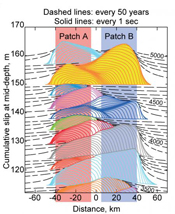
  • Finally, "silent earthquakes" (or a slow slip events) have been discovered here. These occur so slowly that a single "earthquake" can last as long as a month, and the seismic waves they produce, called tremors, are so weak that we cannot feel them.

Scientists at the TO have been investigating the Mexican subduction zone to shed more light on these unusual features. New research results show that the subducting plate has flattened out to near horizontal and is hugging the crust above it. This has cut off the deep earthquakes and moved the volcanic arc inland. A thin layer has been discovered inbetween the two plates, and is shown to be associated with silent earthquakes and swarms of tremors.


Current News

NEWS ARCHIVE >

TO annual meeting coming up, November 4 and 5, 2009

Brian Wernicke is interviewed on National Geographic's television show America's Wild Spaces: Death Valley (July 20, 2009) - Brian discusses how Death Valley was formed by the earth rifting apart, and shows how we use continuous GPS to measure the rate at which the valley continues to open up.

Owen Weller (SURF student) - recipient of Dr. Stoneley's Prize, of Pembroke College, Cambridge, for top Geology and Geophysics BA examination result (July 13, 2009).

Will You Finish Your Thesis on Time (UTube)
Musical performance by four GPS graduate students at the Division's Zilchbrau, an annual celebration organized by 2nd-year graduate students. The performers are (from left to right) Alan Chapman, Steven Kidder, Andrew Matzen, and Steven Chemtob.

Geology grad students lead kids on an educational hike (June 2009)
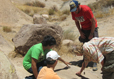
Three graduate students from Caltech's Tectonics Observatory recently led a class of 40 sixth graders from Burbank Elementary School on a geology field trip through Eaton Canyon.

Aron Meltzner and Anthony Sladen are interviewed on France's television show Thalassa about the recent earthquakes in Indonesia (May, 2009) - Aron explains how coral studies reveal the region's history of earthquakes, while Anthony explains why this region is so prone to earthquakes (scroll down Thalassa web page to access 2-minute video excerpt, in French language).

Jason and Zorka Saleeby are Keynote Speakers at Kern River Valley's Spring Nature Festival, Audubon (May 2, 2009)
Jason and Zorka Saleeby appeared at the Kern Valley Spring Nature Festival sponsored by the Audubon Society. They presented the yearly banquet keynote address entitled "Kern Valley Backyard Geology," led a workshop on local geology, and led a field trip to the Kern Canyon fault.

Fingerprinting slow earthquakes and how they relate to the big one, ScienceDaily (April 30, 2009)
Team of researchers finds anomalous layer on top of a subducting slab. This layer, called the "ultra-slow velocity layer" (USL), slows seismic waves down by 30% to 50%, and is shown to be coincident with silent earthquakes. (see article in Science)

John Eiler - Recipient of the 2009 Epstein Medal, the European Association for Geochemistry (EAG)'s Science Innovation Award, "for particularly important and innovative breakthrough in geochemistry, considered to be of fundamental significance"

Ken Farley - Recipient of the Geochemical Society's 2009 Goldschmidt Medal, "for outstanding contributions to geochemistry"

Nina (Yu-nung) Lin (graduate student) - Recipient of the American Association of Petroleum Geologists (AAPG) Foundation's Alexander and Geraldine Wanek Named Grant, to fund her work on folding and thrusting mechanisms along the northern TianShan Piedmont (April 2009)

Volcanic Planet, National Public Radio (Mar 26, 2009)
TO's Mark Simons is one of the scientists interviewed about the science of volcanoes, after the eruptions of Mount Redoubt, Alaska and an undersea volano off the coast of Tonga

Caltech Grad Students and Professor participate in local public middle school's Science and Math Fair, Caltech Today (Feb 18, 2009)
Three graduate students and a professor from Caltech's Tectonics Observatory presented hands-on activities in Earth science at Sierra Madre Middle School's Science and Math Fair.

Brian Wernicke discusses the shrinking San Gabriel Valley, TWCable's SoCal News/CNN Headline News (Feb 11, 2009)
A two-minute news interview, with Brian Wernicke explaining how the San Gabriel Valley came to be and where it's going.

Imperfect Dominoes, Nature Geoscience (Feb 2009)
Studies of past and present seismic activity in the Indonesian archipelago show a complex, but organized, pattern of earthquake supercycles, the latest of which has not been completed.

Reef record suggests impending Sumatra quakes, ScienceNews (Dec 11, 2008)
Analyses of corals surrounding the Mentawai Islands indicate that the Sumatra region has suffered repeated supercycles of seismic upheaval for at least seven centuries. Results of the new studies suggest that the Mentawai Islands' September 2007 temblor is just the first in a series of major temblors that will strike that region in the coming decades.

NEWS ARCHIVE >

Research Highlights


© Tectonics Observatory :: California Institute of Technology
Last updated: November 13, 2009 | Contact Us

Seismological LaboratoryGPS


Tectonics Observatory